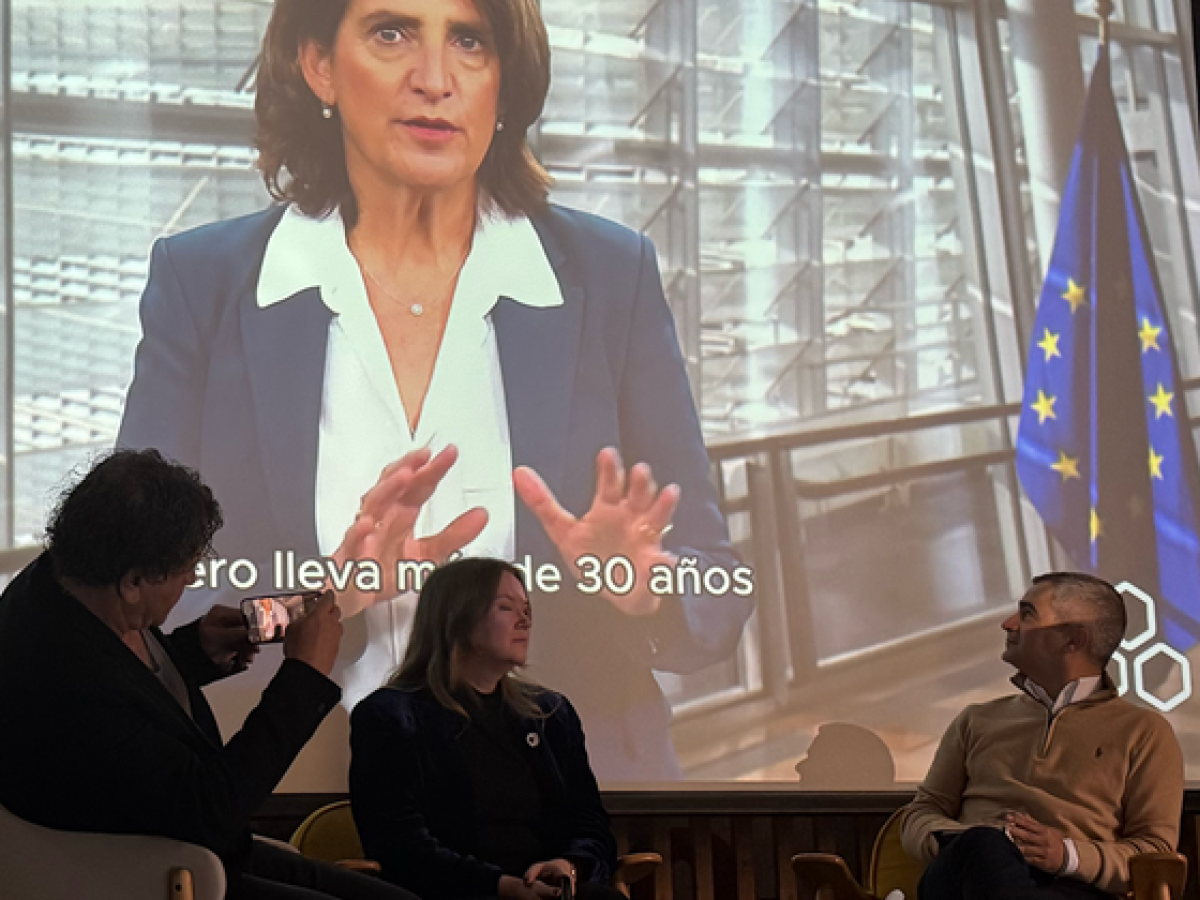
EU Vice-President Teresa Ribera at the PACESETTERS Summit
Artistic research and strengthening its role in European policy were main themes of the PACESETTERS Summit earlier this November. From the Society for Artistic Research and the Journal for Artistic Research, SAR President Florian Schneider, SAR Executive Officer Johan A Haarberg and JAR Editor-in-chief Michael Schwab presented, contributed and participated in key sessions throughout the Summit.
The arts and culture are not a by-product; they are the driving force behind European competitiveness. In her speech at the PACESETTERS Summit, Teresa Ribera, Executive Vice-President of the European Commission, made a notable contribution to the ongoing discussion about European competitiveness, emphasising the importance of creativity and, in particular, collective and artistic intelligence.
“Our social, cultural and environmental standards are not obstacles to competitiveness. On the contrary, they are its foundation”, she said. European competitiveness depends on key factors including the arts and culture, heritage and creativity. Europe's strength lies in its linguistic, cultural and historical diversity which provides unique opportunities to drive societal change, advocate for clean and just transitions and prepare the ground for innovation.
"Across our continent many feel fatigue. Many feel exhausted by endless crisis and the sense that creativity and confidence are being depleted. Yet, this is precisely where Europe’s strength lies: In our ability to connect with others and to be inspired, to create, to facilitate, to ensure that through innovation and creativity, in our capacity to let art, culture and values guide how we act.”
PACESETTERS Summit took place from 12 to 16 November 2025 in La Termica, a the cultural centre and former hospital in Málaga. The event brought together artists, creators, researchers and policymakers for five intensive days in a “Polyclinic of creative practice”. PACESETTERS is the first Horizon Europe-funded research project to position artistic and practice-based research at the heart of its methodology.
As the climate crisis unfolds and its direct and indirect consequences become increasingly evident and complex, the ambition to transition rapidly yet smoothly to renewable energies appears to be fading away from political agendas. This creates an urgent need to develop new strategies for moving forward and getting ahead together.
Rather than raising awareness of apocalyptic scenarios, dreaming of behavioural manipulation or perpetuating a culture of complaint, the PACESETTERS Polyclinic proposes measures driven by artistic intelligence, promoting creative subsistence and building aesthetic resilience — the capacity to maintain and restore integrity while adapting to and shaping societal, technological and cultural change.
“Let us reclaim competitiveness as collaboration. Let us make Europe’s diversity, linguistic, cultural and territorial, our most powerful asset”, said Ribera. “At a moment when the future feels uncertain, we need the courage to imagine boldly, work together and turn ideas into action.”
A video recording of Teresa Ribera’s statement and an English transcription of her speech are available on the PACESETTERS website. In 2026, the PACESETTERS 'Polyclinic of Creative Practice' format will continue to be developed in the three Real World Laboratories in Genalguacil, Galway and Nowa Huta, as well as in six planned Local Impact Academies in Berlin, Prague, Brussels, Oslo, Dublin and Sarajevo.
https://pacesetters.eu/summit/program/14/12
The Summit's focus on positioning artistic research within the emerging EU-level agendas aligns closely with SAR's long-term advocacy of recognising artistic research and its methodologies. They are essential for addressing complex challenges relating to climate change, digital transformations, and social justice. For SAR, its members, and the wider artistic research community, this work is of the utmost importance. Each step towards embedding artistic research in European policy frameworks strengthens the community's visibility, legitimacy, and long-term support structures.